The business of music entertainment is undoubtedly a complex industry, subject to a diverse catalog of cultural, economic, social and political influences. Still, the industry has experienced a remarkable transformation: from a practice enjoyed and cherished by a select few artistically-inclined individuals to a multi-billion-dollar product handled by a slew of money-grabbing personas capitalizing on its mass-media marketability. Its relatively brief history is seasoned with a variety of cutting-edge advancements, constant ongoing evolutionary enhancements, and forward-thinking business moguls that have collectively liberated consumers from the binds of mass music outlets.
Music as a commodity for mass consumption is a product of the evolving world, specifically the convergence of technology that has enabled music to become a marketable and profitable product. Such evolution has proved to be key in the development of future music streaming services. Establishing a shared and reliable meaning between the encoder and decoder is vital to communicating a product to the consumer (Baran, 6). The introduction of the radio as a music-broadcasting medium in the early 1900’s was the first step towards establishing music as widespread token of mass media entertainment that stretched beyond the limitations of live performances.
Soon after came the popularization of an older piece of technology: vinyl players and vinyl records, the primary medium used for music reproduction throughout the 1900’s. These players allowed individuals to curate their own musical collections and enjoy the luxury of album choice, rather than being bounded by the moderated sound of genre-based radio stations.
Then came cassette players; a monumental breakthrough allowing one to condense their personal musical collections into compact and portable cassettes, playable wherever one so pleases.
And now here we are, immersed in the age of digital dominance, with a variety of compatible technologies capable of accelerating growth in a variety of digital markets (music, movies, shows, podcasts, etc.). We once were a people ecstatic over owning a clunky device that housed a mere thousand songs. Now, thanks to these breakthroughs in hardware, software, and the increased demand in media consumption, we can now effortlessly offer every individual access to a seemingly infinite number of musical files, available at the touch of a screen.
As remarkable as the evolution of the music industry is, the way music-streaming-service giants have monopolized the music industry is an equally praiseworthy feat. Modern music streaming services, such as Spotify, Apple Music, and TIDAL, have grown into the leaders of mass media entertainment, representing the apex of over two decades of ground-breaking technological advancements in the music-consumption industry. All together, these industrial giants have been able to decentralize free and open-market music services (Napster, SoundCloud, etc.), effectively convincing the masses that subscription-based packages are the true entry points to an endless ocean of music and audio media. But how did we get here?
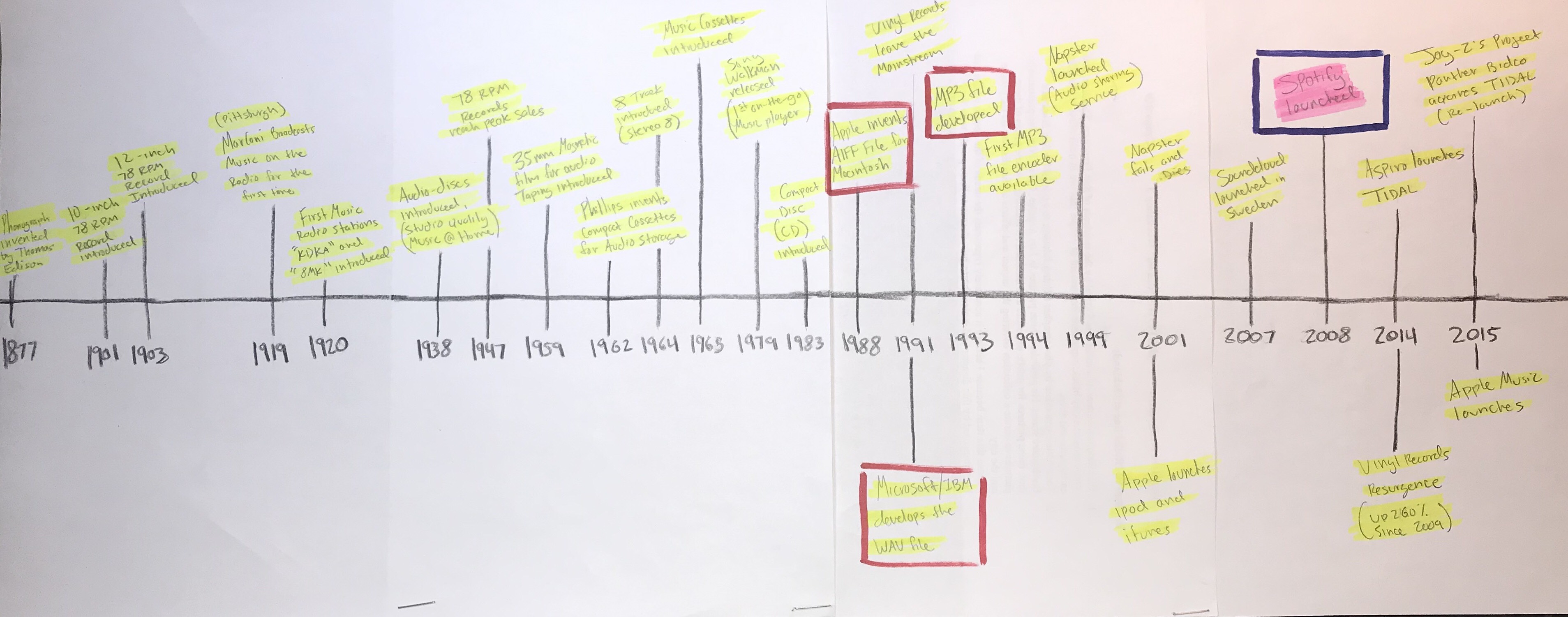
Early audio engineers and architects were the first to lay the foundational framework of a soon-to-be prosperous industry. The state of audio file formats in the 1980’s remained confined to life on the radio or on clunky cassettes. Anxious for a breakthrough in audio file formatting, encoders around the world schemed for a format that would encode digital audio into files transferable from studios to personal devices.
WAV and AIFF files were introduced as the answer, however, although these audio formats did solve the initial problems of musical availability, file size made it difficult to transfer multiple musical files. WAV and AIFF files are both uncompressed files, meaning that they were rich in sound and maintained studio level quality with very little cut-offs or compromises, yet without compression the files remained extremely large and took up a ton a space on your devices disk. The computers of the 1990’s simply were not ready to receive such large files in multitudes and remain reasonably operational. The technology involved was not designed to perform such tasks.
In order to convert a vision of functional and accessible musical platforms into a reality, a smaller audio file size was needed, and that’s where the MP3 file came in. MP3 encoded WAV or AIFF files into encrypted files only a few megabytes in size. These coded files then could be transferred, shared, and streamed effortlessly as long as: the internet used could support online file transfers and the receiving device was equipped with a processor that could decrypt MP3 files.
With the creation of the perfect audio file already presented to the world, industry architects began developing internet services, computers and devices that would allow MP3 files to succeed. The convergence of formatted information, high speed connectivity, and technological advances enabling our devices to do more, exemplifies Baran’s key elements in the evolution of technology as an increasingly important part of our world (41). The involved technologies would then be tied to a single point, effectively eroding any technological distinctions and producing a musical platform equipped with high speed connectivity, loads of formatted information, intelligent algorithms and a substantial amount of personal options. The introduction of the MP3 and the technology that followed hinted at a future where music of any kind would be accessible to all from a single device.
Contrary to the many business plans that planned to capitalize on the MP3 file, open-source platforms like Napster provided the people with a free platform easily accessible to share and post music files, giving the public access to an abundance of tracks, which could be streamed and downloaded for free in MP3 format. This type of platform caused panic in the music streaming industry. If free music was accessible to all, then the need to create pay-to-listen platforms would fade.
However, a majority of the consumers active on these open-source platforms experienced the crippling-slow internet speeds of public servers and networks in the early 2000’s, giving pay-to-listen companies an early advantage that would ultimately propel them to the top of the music industry. Companies such as Apple’s iTunes (now Apple Music) provided fast, secure, and closed servers that were interconnected solely with Apple devices, creating a functional music streaming experience, an experience worthy of payment. As long as the music companies followed in Apple’s footsteps (provide fast and flawless access to a vast pool of tracks and audio files via interconnected servers that are smooth and secure) then consumers would be sure to flock to them and pay a premium for a burden-free “futuristic” music streaming service.
Advancements in technology with an eye for consumer convenience has proven to be the future of media development. According to Twenge, in chapter 2 of her book iGEN, “nearly all of their [teens] leisure hours are now spent on new media” (51). With the reality of the future fully realized, visionaries in the industry strived to plow a successful path for the future. And although the road to success had been paved, minor problems continued to hinder the music streaming industry.
Before subscription packages were introduced, consumers would be turned off by the fact that one must purchase an album, even if one only wanted a select few songs off each album. The value in buying a few songs was non-existent as the price was identical to just buying the whole album. Consumers wanted full autonomy over their musical choices and wanted prices and values to reflect such, bringing us to the last piece of the modern music streaming industry puzzle: the ability to truly pick and choose at one’s own will.
Audiences and consumers of music aren’t all the same, some people are going to be part of a fragmented audience, or as Baran explains it, “the audience itself is less of a mass audience” (37). SoundCloud, a user-based prosumer-type market provided a demonstration to the world the power of true track selection. SoundCloud at that time (mid 2000’s) seemed like a perfect company that could rule the music streaming market. It was free (like Napster), offered a vast selection of known and unknown artists, and allowed one’s will to always be an on-demand command. However, similar to Napster, the problem of fluidity and security on the platform often made the experience significantly worse in comparison to private and top-regulated platforms.
In 2008 a company by the name of Spotify pieced together the music-streaming puzzle, taking from every platform of the past, and creating the perfect platform for the future. Spotify was founded as a music streaming service where everyone could enjoy all their favorite tracks on-demand, discover new music on-demand, and create their own musical stations on-demand. An all-inclusive package that did not require payments for every little thing (like Apple’s system), but rather required a mere ten dollars a month, an unmatchable value for an unmatchable service.
The rest is history, as present-day 2019 tells a tale of digital dominance. An overwhelmingly majority of phones, laptops, computers, tablets, and smart watches owned in the U.S. and around the world has installed onto its hardrive an application for music-streaming. Whether it be Spotify, Apple Music, Tidal or other open market streaming sources, music is available everywhere. The rapid developments made in the music tech industry forced the founders of the industry to be visionaries capable of converging new tech and popular mediums with desirable products. Nonetheless, the industrial giants of music media entertainment deserve a round of applause for crafting a media service ever-so innovative with a price tag of only ten a month. Although the free-market platforms such as SoundCloud remain part of the streaming landscape, it is safe to say that the future of music streaming will continue to revolve around ten-a-month platforms; platforms that could soon venture into providing a variety of other media services (movies, shows, exclusive videos, etc.).
Works Cited
Baran, Stanley J. “Convergence and the Reshaping of Mass Communication.” In Introduction to Mass Communication: Media Literacy and Culture. New York: McGraw – Hill, 2015. Pp. 29 – 45.
Baran, Stanley J. “Mass Communication, Culture, and Media Literacy.” In Introduction t o Mass Communication: Media Literacy and Culture. New York: McGraw – Hill, 2015. Pp. 3 – 27.
Grannell, Craig. “A history of music streaming.” Dynaudio, May 16, 2018. https://www.dynaudio.com/dynaudio-academy/2018/may/a-history-of-music-streaming
Twenge, Jean. “Internet: Online Time–Oh, and other Media, Too.” In iGen: Why Today’s
Super- Connected Kids Are Growing Up Less Rebellious, More Tolerant, Less Happy–and Completely Unprepared for Adulthood. New York: Simon & Schuster, 2017. Pp. 49-68.

